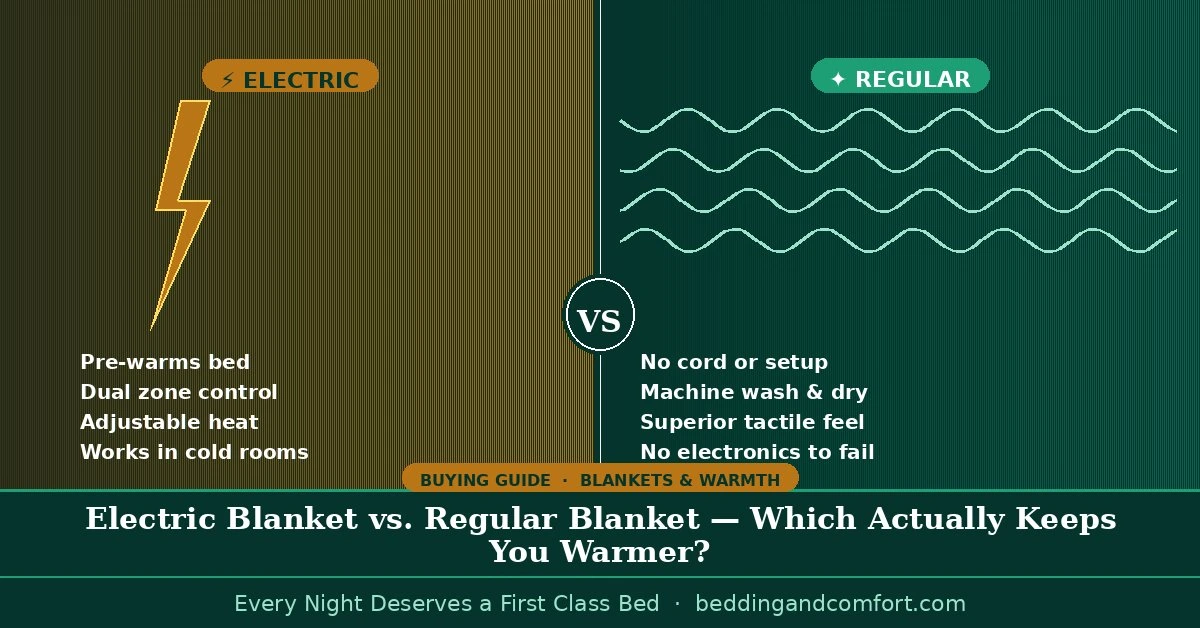
Quick Answer: A regular blanket traps your body heat passively — great for most sleepers in moderate climates. An electric blanket generates its own heat actively — essential for cold sleepers, very cold rooms, and couples with different temperature preferences. Scroll to the Quick-Pick Guide at the end to find your match in 30 seconds.
Every winter, the same question comes up. You're lying there not quite warm enough, wondering whether the blanket you already own is the problem — or whether it's you. Whether a different blanket would actually fix things, or whether you'd just be spending money to end up in the same situation with a more expensive version of the same cold.
The electric blanket vs. regular blanket debate is real, and the answer isn't obvious. They work in completely different ways. One waits for your body to warm it up. The other generates its own heat. Understanding which approach suits your actual sleeping situation — your climate, your bed partner, your budget, your tolerance for cords — makes the decision a lot simpler than most guides make it look.
How They Actually Work — and Why That Difference Matters
A regular blanket — whether it's a heavy cotton quilt, a faux fur comforter, or a flannel Sherpa throw — is passive insulation. It traps the heat your body produces and holds it close to your skin. When you first get into bed, it's cold. Your body warms the air inside the blanket, and over ten or fifteen minutes it becomes comfortable. The better the insulation, the more efficiently it traps that warmth once you've generated it.
An electric blanket works the opposite way. It generates heat actively through a heating wire or element embedded in the fabric. It doesn't wait for your body. It's warm before you get in — or as warm as you've set it to be. Your body heat still contributes, but the blanket is doing the primary thermal work rather than just containing yours.
Passive vs. Active Heating at a Glance
| Feature | Regular Blanket | Electric Blanket |
|---|---|---|
| Heat source | Your body | Built-in heating element |
| Ready when you get in? | No — warms up over 10–15 min | ✅ Yes — pre-warm before bed |
| Works in very cold rooms? | Limited by body heat output | ✅ Active heat — room temp irrelevant |
| Complexity | ✅ None — just use it | Controller, cord, timer to manage |
The Case for a Regular Blanket
Regular blankets have a few things going for them that electric blankets simply can't match. If your sleeping situation doesn't demand active heat generation, a quality non-electric blanket will outperform on almost every other measure.
Pros of Regular Blankets
- Zero setup — no cord, no controller, no timer. Throw it over yourself and that's it.
- Fully machine washable and dryable — toss it in, it comes out clean and lofted. No air-drying step.
- Higher tactile quality ceiling — the best Sherpa, faux fur, and microfiber blankets feel like a cloud — no wire running through the fabric to interrupt the texture.
- Longer lifespan — no electronics means nothing to fail. A quality blanket degrades gracefully over years without any functional breakdown.
- No safety considerations — no heating element means no auto-off settings to manage, no overheating risk, and no restrictions around pets or children.
Cons of Regular Blankets
- Cold at first — relies entirely on your body heat, so it takes 10–15 minutes to feel comfortable after getting in
- Can't pre-warm the bed — no way to have a warm bed waiting for you
- No temperature control — you add or remove layers; there's no dial
- Limited in very cold rooms — body heat alone can't overcome a genuinely cold environment
- One temperature for two people — no way to give each sleeper independent warmth control
The Case for an Electric Blanket
Electric blankets solve specific problems that regular blankets simply cannot. If any of the four scenarios below describe your sleeping situation, a regular blanket — no matter how thick or expensive — will never fully fix the problem.
Pros of Electric Blankets
- Pre-warms the bed — turn it on 15 minutes before you get in; your bed is warm when you arrive. A regular blanket will never do this.
- Dual zone control — each side of the bed has independent heat settings. The definitive solution for couples with different temperature preferences.
- Works in genuinely cold rooms — active heat generation overcomes ambient cold in ways passive insulation cannot
- Precise temperature control — 10 calibrated heat levels from 86°F to 107.6°F; adjust from the nightstand without getting up
- Energy efficient — runs at 50–100 watts vs. a space heater at 1,500 watts — warming your bed costs a few cents per night
Cons of Electric Blankets
- Cord and controller to manage — a cable runs across the bedroom floor; the controller needs to be set, stored, and occasionally charged
- Air dry only — most electric blankets cannot go in the dryer — machine wash only with the controller removed
- Lower tactile ceiling — the wire running through the fabric affects the feel — it rarely matches the pure softness of a premium non-electric Sherpa or faux fur
- Electronics can fail — the heating element has a finite lifespan unlike a simple fabric blanket
- Safety considerations — keep away from unsupervised pets and young children; always use the auto-off feature
Electric vs. Regular Blanket: Head-to-Head Comparison
| Factor | Regular Blanket | Electric Blanket |
|---|---|---|
| How it heats | Traps your body heat | Generates its own heat |
| Pre-warming the bed | ❌ Not possible | ✅ Set it 15 min before bed |
| Dual zone (couples) | ❌ Same temp both sides | ✅ Independent zone control |
| Tactile luxury | ✅ Higher ceiling — no wire | Good — but wire is present |
| Care & washing | ✅ Machine wash & dry | Machine wash only — air dry |
| Temperature control | Layer more or fewer blankets | ✅ Precise levels with display |
| Very cold rooms | Limited by body heat output | ✅ Active heat — independent of room temp |
| Simplicity | ✅ No setup, no controls | Controller, cord, timer to manage |
| Longevity | ✅ No electronics to fail | Heating element has a lifespan |
Which Should You Choose? 5 Real Scenarios
Scenario 1: You sleep in a reasonably warm room and run at a normal body temperature.
A quality regular blanket is all you need. A 200 GSM Sherpa or thick microfiber comforter will keep you comfortable all night with zero setup required. Spend the savings on a better pillow.
Scenario 2: You and your partner constantly disagree about how warm the bed should be.
This is the electric blanket's single strongest use case. A dual-zone electric blanket gives each side of the bed its own independent heat setting — the definitive solution to the most common bedroom temperature conflict.
Scenario 3: You hate getting into a cold bed on winter nights.
Electric blanket, no question. Turn it on 15 minutes before bed and your sheets are warm when you arrive. A regular blanket — however thick — cannot pre-warm a bed. This is a physical limitation, not a quality issue.
Scenario 4: You want the most luxurious, tactile blanket feel possible.
Go with a regular blanket. A premium faux fur, Sherpa, or thick microfiber blanket without a heating wire delivers a softness and weight that no electric version fully replicates. Tactile quality is where regular blankets genuinely win.
Scenario 5: Your bedroom gets genuinely cold in winter — below 60°F, poor insulation, hard climate.
Electric blanket. In a very cold room, your body simply doesn't generate enough heat to overcome the ambient cold, and layering more blankets only slows the heat loss. Active heat generation is the only real solution.
Questions We Hear a Lot
Is it safe to sleep with an electric blanket on all night?
Modern electric blankets with auto shut-off are designed for overnight use — the auto-off feature activates after a set period (typically 10–12 hours). Always follow manufacturer care instructions: don't fold the blanket while it's on, ensure it's fully dry before use, and keep pets and young children away from unsupervised use. Auto shut-off is a non-negotiable feature worth confirming before you buy.
Can I use an electric blanket on top of a regular comforter?
Yes — and this is a common and effective setup. Use the electric blanket as a base layer underneath a comforter for maximum warmth retention, or on top as the heat source with the regular blanket below for tactile softness. Avoid sandwiching the electric blanket between two heavy, dense layers that could trap heat and cause overheating.
Do electric blankets use a lot of electricity?
No — they're one of the most energy-efficient ways to stay warm at night. A typical electric blanket runs at 50–100 watts, compared to a space heater at 1,500 watts. Running an electric blanket for 8 hours overnight costs roughly a few cents at standard electricity rates — far less than heating a whole room to sleeping temperature.
What's the difference between a heated throw and a heated blanket?
Size and intended use. A heated throw (typically around 50"×60") is sized for single-person sofa or chair use — portable, compact, and ideal for living room evenings rather than sleeping. A heated blanket in Twin, Full, or larger is sized for bed use and typically includes dual zone control. The throw is the casual companion; the full-size electric blanket is the bed upgrade.
How do I choose between a Sherpa blanket and a regular comforter for winter?
It comes down to weight preference and sleeping style. A Sherpa blanket is typically lighter in fill but very warm due to the plush construction — it performs above its weight class and has a tactile quality that feels almost therapeutic. A comforter provides warmth through fill density and loft rather than surface texture. Side sleepers who move around often prefer the drape of a lighter Sherpa; back sleepers who don't move much often prefer the even warmth distribution of a comforter.
Quick-Pick Guide: Find Your Blanket in 30 Seconds
Choose a REGULAR BLANKET if: You sleep at a normal or warm temperature • Your bedroom is reasonably insulated • You want the simplest possible setup • You want fully machine wash and dry • You and your partner agree on warmth • Tactile luxury is your top priority.
Choose an ELECTRIC BLANKET if: You sleep cold regardless of layering • Your bedroom gets genuinely cold in winter • You hate getting into a cold bed • You and your partner disagree on temperature • You want precise, adjustable warmth control • You're willing to manage a cord and controller.
Consider BOTH if: You want the tactile softness of a premium regular blanket as your primary layer • Plus an electric blanket for pre-warming or especially cold nights • This is the smartest setup for most cold-climate households.
What We Carry at Bedding and Comfort
If you've decided on an electric blanket, the edx Electric Heated Blanket is the most fully specified option on the site — 10 heat levels from 86°F to 107.6°F, dual zone control on the Twin and Full sizes, a 19.4ft cord, and 200 GSM flannel and Sherpa construction. Starting at $49.99 for the Throw size.
Need international voltage compatibility or a larger size? The 110–220V plush electric blanket covers US, European, UK, and Australian outlets and comes in a three-person dual zone size at $89.11.
If you're leaning toward a non-electric option, our full blankets and comforter sets collection covers everything from thin seasonal quilts to thick faux fur comforter sets — something for every winter preference and every room.
