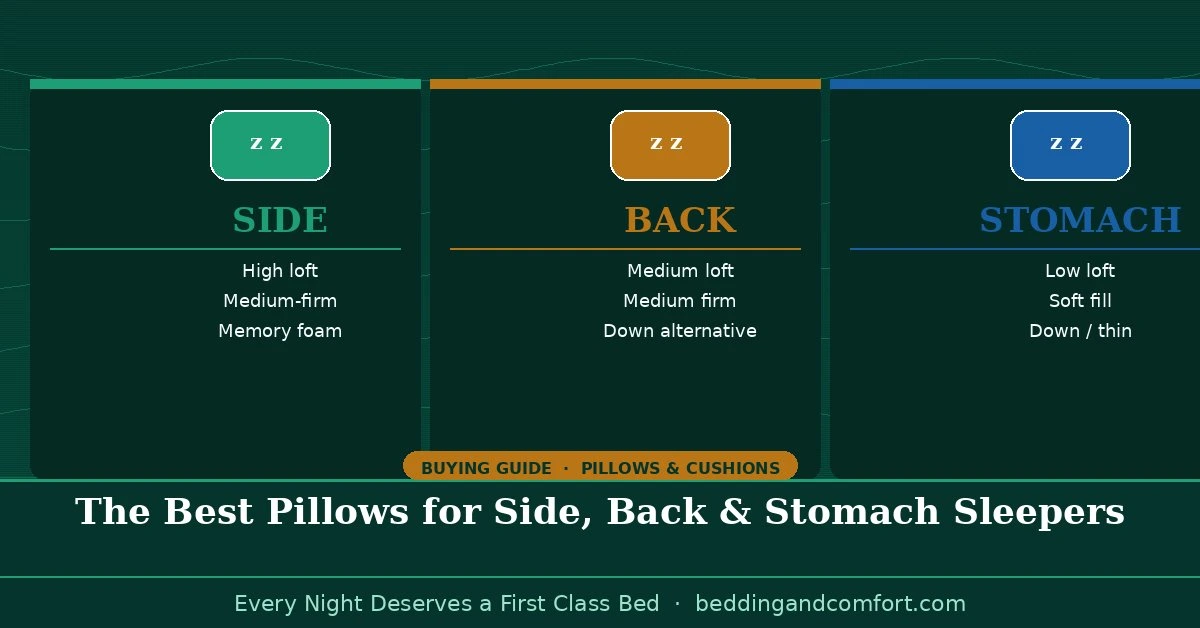
Quick Answer: Side sleepers need a firm, high-loft pillow. Back sleepers need medium support with a slight neck curve. Stomach sleepers need a thin, soft pillow — or no pillow at all. Scroll to our Sleep Position Finder at the end to get your match in 30 seconds.
You've probably never thought twice about your pillow. It's just... there. But if you wake up with a stiff neck, sore shoulders, or a headache you can't explain, your pillow is almost certainly the problem — not how you slept.
The single most important factor in choosing a pillow isn't the brand, the price, or even the fill material. It's your sleep position. A pillow that's perfect for a side sleeper can cause real neck strain for a back sleeper, and vice versa. This guide breaks it all down so you can finally wake up without that morning ache.
Why Your Sleep Position Determines Your Pillow
When you sleep, your spine needs to stay in a neutral alignment — meaning your head, neck, and shoulders should form a straight, natural line, the same way they do when you're standing upright with good posture. The role of your pillow is to fill the gap between your head and the mattress so that neutral position is maintained all night.
The gap between your head and the mattress is a completely different size and shape depending on whether you sleep on your side, back, or stomach. That's why one pillow can never truly work for all three positions — and why knowing your sleep style is the essential first step.
Key Pillow Terms Explained
| Term | What It Means |
|---|---|
| Loft | The height of the pillow. Low loft = thin. High loft = thick. |
| Firmness | How much resistance the pillow offers when you press into it. Soft, medium, or firm. |
| Support | How well the pillow keeps your neck and spine in alignment throughout the night. |
| Fill Material | What's inside the pillow — memory foam, down, latex, polyester, or a blend. |
Best Pillows for Side Sleepers
Side sleeping is the most common sleep position — and the one that demands the most from a pillow. When you're on your side, the distance from your ear to the mattress is significant. You need a pillow with enough height and firmness to fully bridge that gap and hold your head level with your spine.
A pillow that's too flat lets your head drop toward the mattress, compressing the side of your neck. A pillow that's too thick pushes your head upward, straining the other side. The sweet spot is a high-loft, medium-to-firm pillow that keeps everything level.
What Side Sleepers Should Look For
- Loft: High — 4 to 6 inches to fill the shoulder-to-head gap
- Firmness: Medium-firm to firm — needs to resist compression under the weight of your head
- Best fill: Memory foam or latex — both hold their shape consistently all night
- Avoid: Soft down pillows — they compress too easily and lose loft mid-sleep
- Bonus tip: Place a second pillow between your knees to keep your hips aligned too
Warning Signs Your Side Pillow Is Wrong
- You wake up with pain or stiffness on one side of your neck
- You fold or stack pillows to feel comfortable
- Your shoulder feels numb or sore in the morning
- You find yourself sleeping with your arm under your head for extra height
Best Pillows for Back Sleepers
Back sleeping is considered the healthiest position for spinal alignment — but only if your pillow is right. When lying flat on your back, you need a pillow that supports the natural inward curve of your neck (called the cervical curve) without pushing your head too far forward.
The most common mistake back sleepers make is using a pillow that's too thick, which tilts the chin toward the chest and puts strain on the back of the neck. A medium-loft, medium-firm pillow is almost always the right answer.
What Back Sleepers Should Look For
- Loft: Medium — 3 to 5 inches, just enough to support the neck curve
- Firmness: Medium — soft enough to cradle the head, firm enough to support the neck
- Best fill: Down alternative or contoured memory foam — both offer gentle, consistent support
- Look for: A contoured or cervical pillow — designed with a slight dip in the center for the head and raised edges for the neck
- Bonus tip: Place a pillow under your knees to relieve lower back pressure
Warning Signs Your Back Pillow Is Wrong
- You wake up with upper back or neck stiffness
- Your chin feels tucked toward your chest when lying down
- You find yourself sliding off the pillow during sleep
- You wake up with a headache at the base of your skull
Best Pillows for Stomach Sleepers
Stomach sleeping is the hardest position on your spine and neck — because your head is rotated to one side for hours at a time. If you're a committed stomach sleeper, the most important thing your pillow can do is get out of the way as much as possible.
The goal is to keep your head as close to mattress level as possible to reduce the angle your neck has to twist. That means a very thin, very soft pillow — or in some cases, no pillow under the head at all, with a flat pillow under the stomach instead to support the lower back.
What Stomach Sleepers Should Look For
- Loft: Low — 2 to 3 inches maximum to minimize neck rotation angle
- Firmness: Soft — compresses easily so the head sinks closer to mattress level
- Best fill: Soft down or down alternative — both compress naturally under the weight of the head
- Consider: No head pillow — place a thin pillow under the stomach and pelvis instead to align the spine
- Avoid: Memory foam or latex — they hold their shape and keep the head elevated, worsening neck strain
Warning Signs Your Stomach Pillow Is Wrong
- You consistently wake up with neck pain on the same side every morning
- You feel lower back pain that you can't explain from daytime activity
- You remove your pillow during the night without realising
- Your upper back or shoulders feel tight throughout the day
Pillow Fill Materials: Which Is Best for You?
Once you know your sleep position, the next decision is fill material. Each type has different support characteristics, price points, and care requirements:
| Fill Type | Best Position | Firmness | Price Range | Washable? |
|---|---|---|---|---|
| Memory Foam | Side, Back | Medium–Firm | $40 – $150 | Cover only |
| Latex | Side, Back | Firm | $60 – $200 | Cover only |
| Down | Back, Stomach | Soft | $50 – $250 | Dry clean |
| Down Alternative | All positions | Soft–Medium | $20 – $80 | ✅ Machine wash |
| Buckwheat | Side, Back | Firm (adjustable) | $50 – $120 | Cover only |
What If You Switch Positions During the Night?
Most people shift positions at least once or twice during the night. If you're a combination sleeper — someone who moves between side and back, or back and stomach — you need a pillow that can handle more than one scenario.
Side + Back sleeper: Choose a medium-loft, medium-firm pillow. It provides enough height for side sleeping while still supporting the cervical curve when you roll onto your back. A shredded memory foam pillow with adjustable fill is ideal — you can add or remove fill to dial in the perfect height.
Back + Stomach sleeper: This is the trickiest combination. Opt for a soft, medium-loft pillow that compresses easily when you're face-down but still provides some support when on your back. A soft down alternative pillow is usually the best fit.
Side + Stomach sleeper: Prioritize your dominant position — whichever you spend the most time in. If in doubt, go with a medium pillow and add a flat pillow under your stomach when face-down to reduce neck rotation.
Sleep Position Finder: Your Pillow in 30 Seconds
Side Sleeper: High loft • Medium-firm • Memory foam or latex • 4 to 6 inches thick
Back Sleeper: Medium loft • Medium firmness • Down alternative or contoured foam • 3 to 5 inches thick
Stomach Sleeper: Low loft • Soft • Down or down alternative • 2 to 3 inches thick (or no pillow)
When Should You Replace Your Pillow?
Even the best pillow doesn't last forever. Over time, fill compresses and loses its ability to support your neck properly. Here's a simple guide to pillow lifespan by fill type:
| Pillow Fill | Replace Every | Quick Test |
|---|---|---|
| Down / Down Alternative | 1 – 2 years | Fold in half — if it stays folded, replace it |
| Memory Foam | 2 – 3 years | Check for permanent indentations or yellowing |
| Latex | 3 – 4 years | Press and release — should spring back immediately |
| Buckwheat | 3 – 5 years | Hulls can be topped up — replace when musty smell develops |
The Bottom Line
The right pillow isn't about the most expensive option or the most popular brand — it's about matching the pillow to the way your body actually sleeps. Side sleepers need height and firmness. Back sleepers need medium support that follows the natural curve of the neck. Stomach sleepers need as little pillow as possible.
Get that match right and you'll notice the difference within the first night. At Bedding and Comfort, we carry pillows across every fill type, loft, and firmness level — so whatever your sleep position, your perfect pillow is already in our collection.
