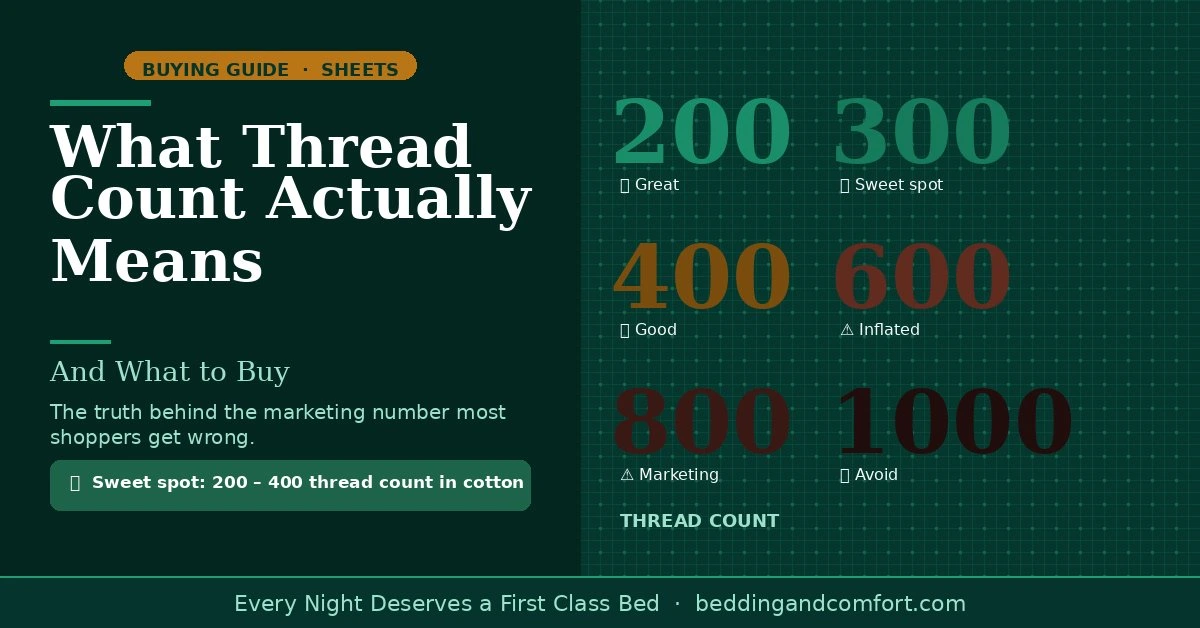
Quick Answer: For most sleepers, a thread count between 200 and 400 in 100% cotton is the sweet spot. Numbers above 400 are usually a marketing tactic, not a quality indicator. What matters far more than the number is the fabric type and weave. Scroll to the Quick-Pick Guide at the end to find your ideal sheets in 30 seconds.
Thread count is probably the most misunderstood number in bedding. Manufacturers have spent decades conditioning shoppers to believe that a higher thread count means a better sheet. The result: shelves full of "1000 thread count" sheets that feel scratchy and stiff, priced at a premium for a number that was inflated to look impressive on a tag.
The truth is simpler — and more useful. Thread count is one factor in sheet quality, not the only one. Fabric type, weave construction, and fiber quality all matter as much or more than the number. Once you understand how they work together, choosing the right sheets becomes genuinely straightforward.
What Thread Count Actually Means
Thread count measures the number of threads woven into one square inch of fabric — both horizontal threads (the weft) and vertical threads (the warp) combined. A sheet with 200 horizontal and 200 vertical threads per square inch has a thread count of 400.
In theory, more threads per inch means a denser, smoother, softer fabric. In practice, thread count became a marketing number that manufacturers learned to inflate — by using multi-ply threads (twisting two or three thin threads together and counting each one separately) or by using lower-quality fibers packed tightly to hit a high number. The result is that a 600 thread count sheet made with multi-ply low-quality cotton can feel worse than a 300 thread count sheet made with single-ply long-staple cotton.
Thread Count by the Numbers
| Thread Count | Quality Indicator | What to Expect |
|---|---|---|
| Under 200 | Entry-level | Rough texture, durable for utility use, not ideal for sleeping |
| 200 – 400 | ✅ Sweet spot | Soft, breathable, durable — ideal for most sleepers in most climates |
| 400 – 600 | Good — if genuine | Can be excellent with quality cotton; watch for multi-ply inflation |
| 600+ | ⚠️ Marketing territory | Almost always inflated — can feel heavy, less breathable, lower actual quality |
Why Fabric Type Matters More Than the Number
A 300 thread count sheet made from Egyptian cotton long-staple fiber will outlast, outperform, and feel better than a 600 thread count sheet made from short-staple cotton with multi-ply threads. Here's why: thread count only tells you how many threads there are. It says nothing about how long, how strong, or how fine those threads are.
Long-staple cotton fibers (like Egyptian, Pima, or Supima) are longer, smoother, and stronger than standard short-staple fibers. Longer fibers produce finer threads, which create softer, more durable fabric even at moderate thread counts. Short-staple fibers produce rougher threads that pill and wear faster — and packing more of them into a square inch doesn't fix the underlying quality problem.
The Main Sheet Fabrics Compared
| Fabric | Feel | Breathability | Best For | Price |
|---|---|---|---|---|
| Percale Cotton | Crisp, cool | ★★★★★ | Hot sleepers, warm climates | $$ |
| Sateen Cotton | Silky, smooth | ★★★ | Luxury feel, cooler climates | $$ |
| Egyptian Cotton | Ultra soft, durable | ★★★★ | Long-term investment, all climates | $$$ |
| Microfiber | Soft, wrinkle-resistant | ★★ | Budget buyers, easy care | $ |
| Linen | Textured, gets softer | ★★★★★ | Hot sleepers, humid climates | $$$ |
Percale vs. Sateen: The Weave Makes a Bigger Difference Than You Think
Two sheets can have identical thread counts and identical cotton quality but feel completely different because of their weave. The weave determines the texture, sheen, weight, and breathability of the finished fabric — and it's one of the most underappreciated factors in sheet buying.
Percale Weave
- Construction: One thread over, one thread under — a tight, even grid pattern
- Feel: Crisp, cool, matte finish — like a freshly ironed dress shirt
- Breathability: Excellent — the tight even weave allows maximum airflow
- Best for: Hot sleepers, warm climates, anyone who hates waking up warm
- Gets better with washing: Yes — percale softens naturally over time without losing structure
Sateen Weave
- Construction: Four threads over, one thread under — more threads exposed on the surface
- Feel: Silky, smooth, subtle sheen — closer to a luxury hotel feel
- Breathability: Moderate — the denser surface traps slightly more heat
- Best for: Cold sleepers, cooler climates, anyone who prioritizes a silky tactile feel
- Note: More prone to pilling and snagging than percale over time
Which Sheets Should You Buy? 5 Real Scenarios
Scenario 1: You sleep hot and wake up sweating.
Choose percale cotton with a thread count of 200–300. The crisp, open weave maximises airflow and keeps the surface cool against your skin. Avoid sateen and anything above 400 thread count — both trap more heat.
Scenario 2: You want a luxury feel without spending a fortune.
A 300–400 thread count sateen in standard cotton delivers the silky, smooth feel most people associate with high-end hotels — without the price tag of Egyptian cotton. This is the best value-per-feel option on the market.
Scenario 3: You want sheets that last 10+ years and get softer over time.
Invest in Egyptian or Pima cotton percale with a 300–400 thread count. Long-staple fibers genuinely improve with washing, and the percale weave holds structure over years of use. It's the one sheet purchase that compounds in quality over time.
Scenario 4: You have kids, pets, or need easy-care sheets that survive constant washing.
Microfiber sheets with a 200–300 thread count equivalent are your best friend. They're wrinkle-resistant, fade-resistant, fully machine washable and dryable, and cost a fraction of cotton. Replace every 2–3 years rather than trying to maintain them long-term.
Scenario 5: You live in a hot, humid climate and struggle with sleep comfort year-round.
Linen is the answer. Thread count doesn't apply to linen the same way — its loosely woven construction is inherently breathable and moisture-wicking. It starts slightly rough and gets significantly softer after every wash. For truly hot sleepers in warm climates, nothing outperforms it long-term.
How to Care for Your Sheets to Make Them Last
Cotton Sheets
- Wash in warm water on a gentle cycle — hot water weakens cotton fibers over time.
- Tumble dry on low heat and remove promptly to reduce wrinkles.
- Avoid fabric softeners — they coat the fibers and reduce breathability over time.
- Wash every 1–2 weeks to prevent oil and skin cell buildup from degrading the fabric.
- Rotate between two sets to extend the life of each one.
Microfiber Sheets
- Wash in cold water on a gentle cycle — heat can damage synthetic fibers.
- Tumble dry on low or air dry — high heat causes pilling and static.
- Wash separately from cotton — microfiber attracts cotton lint.
- Do not use fabric softener — it clogs the microfibers and reduces softness.
Quick-Pick Guide: Find Your Sheets in 30 Seconds
Best for HOT sleepers: Percale cotton • 200–300 thread count • Single-ply • Crisp, cool, maximum airflow
Best for LUXURY feel: Sateen cotton • 300–400 thread count • Egyptian or Pima fiber • Silky, smooth, hotel-quality finish
Best for BUDGET & easy care: Microfiber • 200–300 equivalent • Wrinkle-resistant, fade-resistant • Machine wash and dry • Replace every 2–3 years
The Bottom Line
Thread count is a useful starting point — but it's only one part of the picture. The fabric type, fiber quality, and weave construction matter just as much, and often more. For most sleepers, a 200–400 thread count sheet in quality cotton will outperform a 1000 thread count sheet in inflated multi-ply construction every single time.
At Bedding and Comfort, our sheets and pillowcase collection covers every fabric type, weave, and price point — so finding the right fit for your sleep style and budget is straightforward.
