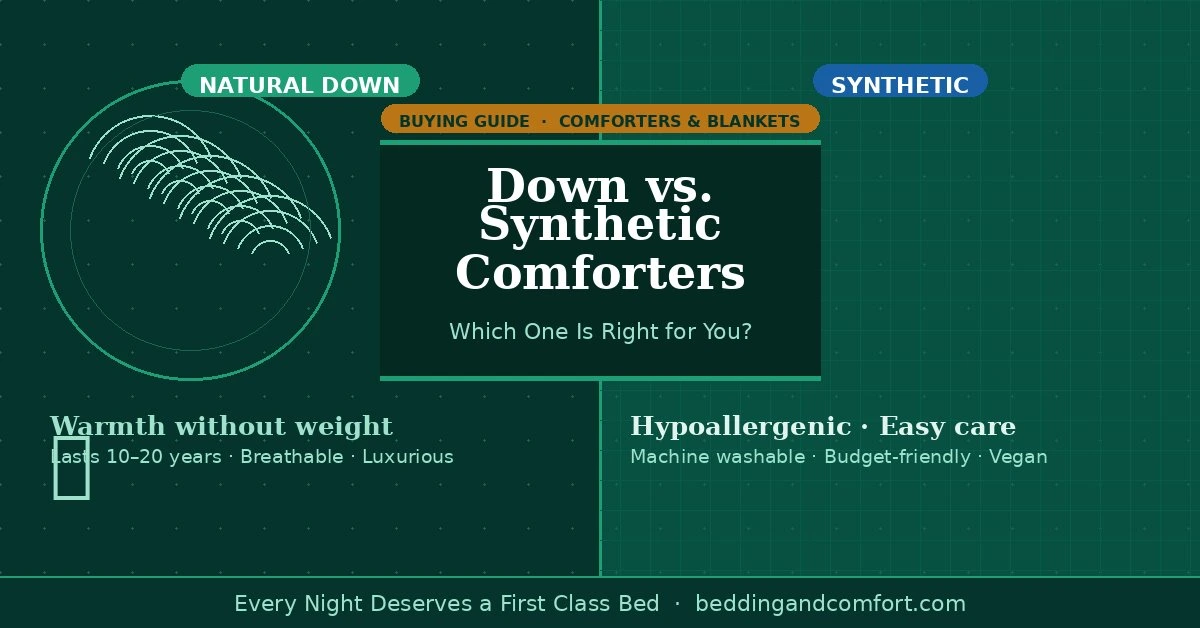
Quick Answer: Down comforters offer unmatched warmth-to-weight ratio and longevity. Synthetic comforters are hypoallergenic, machine washable, and more affordable. Scroll to our Quick-Pick Guide at the end to find your match in 30 seconds.
You've finally decided to upgrade your bedding. You find the perfect comforter listing — then notice it says "700 fill power, Hungarian white goose down." You open another tab, find a highly-rated alternative that's "down alternative, hypoallergenic polyester fill." Same price. Same warmth rating. Completely different materials.
So which should you buy? The honest answer: it depends on four things — your sleep temperature, whether you have allergies, how easy you want care to be, and your budget. This guide covers all four so you can stop second-guessing and start sleeping better.
What Is Down Fill?
Down is the soft, fluffy underlayer of feathers found beneath the outer plumage of ducks and geese. Unlike regular feathers (which are flat and stiff), down clusters are three-dimensional — they trap air in tiny pockets that insulate without weight. That's why a high-quality down comforter can feel almost weightless yet keep you perfectly warm on a cold night.
Understanding Fill Power
Fill power measures how much space one ounce of down occupies in cubic inches. It's the most important number on a down product tag:
| Fill Power | Quality Level | Best For |
|---|---|---|
| 300 – 500 | Entry-level / good | Budget buyers, warm climates |
| 550 – 700 | Mid-range / very good | Most sleepers, year-round use |
| 750 – 900+ | Premium / exceptional | Cold climates, luxury feel |
Pros of Down Comforters
- Exceptional warmth-to-weight ratio — stays warm without feeling heavy or bulky
- Long lifespan — a quality down comforter can last 10–20 years with proper care
- Breathable — naturally wicks moisture and regulates temperature
- Compressible — easy to store, pack, and travel with
- Luxurious feel — the classic hotel-bed experience
Cons of Down Comforters
- Allergy risk — some people are sensitive to down proteins (not the feathers themselves)
- Dry clean only — most high-quality down requires professional cleaning
- Higher cost — quality down comforters typically start at $80 and go well over $300
- Ethical considerations — look for RDS (Responsible Down Standard) certification
- Clumping — without good baffle-box stitching, fill can shift unevenly
What Is a Synthetic (Down Alternative) Comforter?
Synthetic comforters use man-made fill — most commonly polyester microfibers — engineered to mimic the loft and softness of down. Modern synthetic fills have improved dramatically; today's premium alternatives are genuinely hard to tell apart from mid-range down in terms of feel.
You'll see them labeled as "down alternative," "microfiber fill," "Primaloft," "Climashield," or simply "hypoallergenic comforter." These all fall in the same category.
Pros of Synthetic Comforters
- Hypoallergenic — no animal proteins, ideal for allergy and asthma sufferers
- Machine washable — toss it in the washer on a gentle cycle; no dry cleaning needed
- Budget-friendly — great options available from $30–$120
- Vegan/cruelty-free — no animal products used in any part of manufacturing
- Even fill distribution — synthetic fill stays in place without expensive baffle construction
Cons of Synthetic Comforters
- Heavier for equivalent warmth — matching down's loft usually means more fill weight
- Less breathable — polyester traps heat, which can cause night sweats in warm sleepers
- Shorter lifespan — synthetic fill compresses over time, usually 5–8 years
- Environmental footprint — petroleum-based materials; some brands now use recycled polyester
Down vs. Synthetic: Head-to-Head Comparison
| Factor | Down | Synthetic |
|---|---|---|
| Warmth-to-weight | ★★★★★ Excellent | ★★★ Good |
| Allergy Safety | Moderate (RDS certified = safer) | ✅ Hypoallergenic |
| Washability | Dry clean recommended | ✅ Machine washable |
| Lifespan | 10–20 years | 5–8 years |
| Price Range | $80 – $400+ | $30 – $150 |
| Breathability | ★★★★★ Excellent | ★★★ Moderate |
| Best Climate | Cool / cold climates | All climates (warm sleepers too) |
Which Should You Choose? 5 Real Scenarios
Scenario 1: You sleep cold and want the lightest warmth possible.
Down is your answer. A 650+ fill power comforter will keep you warm on freezing nights without the weight of a heavy blanket. Look for a baffle-box construction to keep the fill evenly distributed.
Scenario 2: You or someone in your household has allergies.
Go synthetic — specifically labeled hypoallergenic. Even with certified ethical down, some people react to naturally occurring proteins. A quality microfiber comforter eliminates that risk entirely.
Scenario 3: You have kids, pets, or want easy laundry.
Synthetic wins for practicality. Machine-washable on a gentle cycle, no special detergents, no dry cleaning bill. Down comforters put through a regular washer will clump and never fully recover.
Scenario 4: You want a comforter that lasts 15+ years.
Invest in down. Treated with care, a quality down comforter outlasts most furniture in the bedroom. It's the one bedding purchase that is genuinely worth spending more on.
Scenario 5: You're outfitting a guest room or kids' bedroom on a budget.
Synthetic is the smart play. You get a comfortable, fresh-looking comforter for a fraction of the price — and if something spills, you can wash it at home the same day.
How to Care for Your Comforter
Down Care Tips
- Use a duvet cover to protect the comforter and extend time between cleanings.
- Wash down on a gentle/delicate cycle in warm water — or opt for professional dry cleaning.
- Dry on low heat with 2–3 clean tennis balls to prevent clumping.
- Air out your down comforter monthly — sunlight naturally refreshes down clusters.
- Store in a breathable cotton bag, never in a plastic bag (causes moisture buildup).
Synthetic Care Tips
- Machine wash on a gentle cycle with cold or warm water.
- Use a mild, liquid detergent — avoid powder detergents that can leave residue in the fill.
- Tumble dry on low with dryer balls to keep fill from compressing into lumps.
- Replace when the fill noticeably thins out or loses its loft — typically every 5–8 years.
- A duvet cover extends the life of any comforter — down or synthetic.
Quick-Pick Guide: Find Your Comforter in 30 Seconds
Choose DOWN if: You sleep cold • You want it to last 15+ years • You love a light, airy feel • No allergy concerns • You want a truly luxurious, hotel-quality experience.
Choose SYNTHETIC if: You or family members have allergies • You want machine washable • You sleep hot • Kids or pets in the house • You're on a tight budget • You prefer vegan products.
The Bottom Line
Neither down nor synthetic is universally "better" — the right choice is personal. If warmth, longevity, and a luxurious feel are your priorities (and allergies aren't a concern), down is a worthwhile investment. If you want easy care, allergy safety, and a lower price point, today's synthetic alternatives deliver surprising comfort at a fraction of the cost.
At Bedding and Comfort, we carry both — so whatever your sleep style, you'll find the right match. Browse our full comforter collection below, and if you have questions, our team is always happy to help.
Related Posts
- The Best Pillows for Side, Back & Stomach Sleepers
- What Thread Count Actually Means
- How to Layer Your Bed Like a Luxury Hotel
