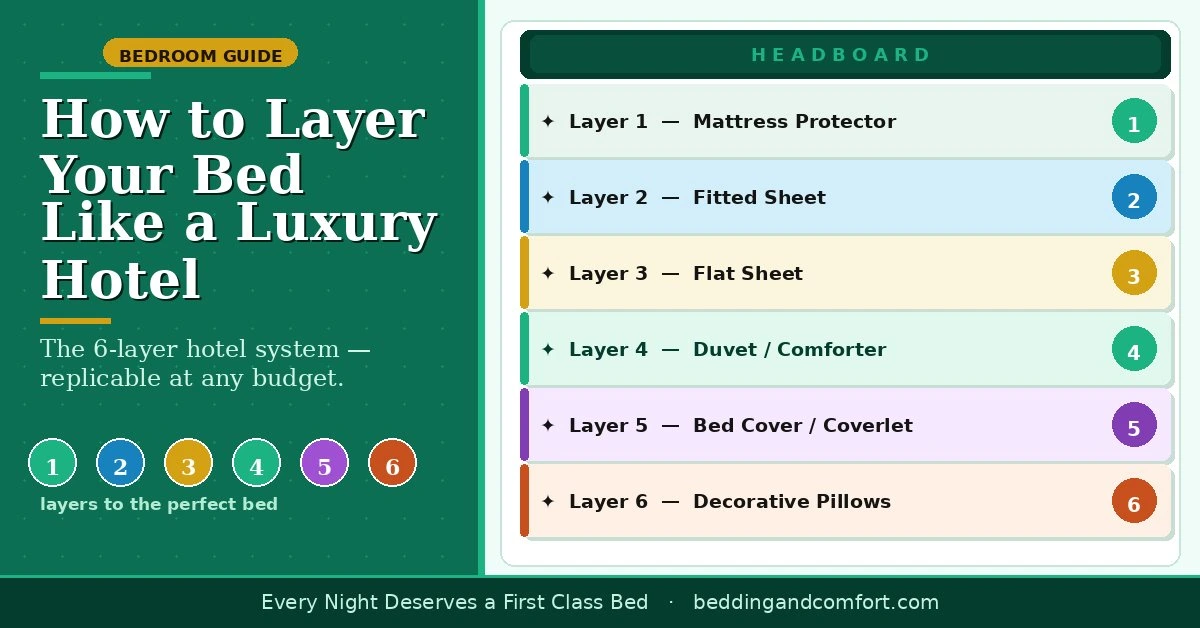
Quick Answer: Luxury hotels use a 6-layer system: mattress protector, fitted sheet, flat sheet, duvet or comforter, bed cover or coverlet, and decorative pillows. The secret isn't expensive products — it's the correct order, tight tucking, and consistent pillow arrangement. Scroll to the Step-by-Step Guide to build your version tonight.
There's a moment when you walk into a hotel room and the bed stops you. It looks perfect — crisp, full, inviting — like someone spent an hour arranging it specifically for you. Then you get home and your own bed looks like a completely different category of object, even if you bought good bedding.
The difference between a hotel bed and a home bed is almost never about price. It's about layering — the specific order and method hotels use to build up a bed from the mattress to the finishing pillows. Once you understand the system, you can replicate it at any budget. This guide walks through every layer, exactly as the hospitality industry does it.
Why Hotels Layer Instead of Just Using One Heavy Comforter
A single heavy comforter is a simple solution — but it has limitations. It's one temperature for all guests, it can't be adjusted during the night, and it doesn't create the visual fullness and structure that makes a bed look luxurious.
Layering solves all three problems. Multiple lighter layers are more temperature-adjustable than one heavy layer — you can add or remove a blanket without fully uncovering yourself. Layering also creates the visual depth and fullness that makes a bed look like a destination rather than a place to sleep.
The Hotel Bed — All 6 Layers at a Glance
| Layer | What It Is | Why It Matters |
|---|---|---|
| 1 | Mattress Protector | Protects the mattress from moisture, allergens, and wear — the invisible foundation |
| 2 | Fitted Sheet | Smooth, wrinkle-free base — white or neutral is the hotel standard for a clean look |
| 3 | Flat Sheet | Acts as a barrier between your body and the duvet — keeps the duvet clean longer and adds a layer of warmth control |
| 4 | Duvet / Comforter | The primary warmth layer — creates the visual fullness and loft that defines a hotel bed |
| 5 | Bed Cover / Coverlet | Folded across the foot of the bed — adds a finished, polished look and a quick extra warmth layer for cold nights |
| 6 | Decorative Pillows | The finishing touch — creates the layered, full headboard look that photographs beautifully and signals a complete bed |
Step-by-Step: How to Build the Layers
Step 1: Start with a mattress protector.
Fit the mattress protector first. It should sit smooth and wrinkle-free across the entire surface. A good mattress protector is waterproof, breathable, and thin enough not to affect the feel of the sheets above it. Hotels replace these regularly — at home, wash yours every 1–2 months.
Step 2: Add the fitted sheet with hospital corners.
Pull the fitted sheet taut across all four corners so there are no wrinkles or loose fabric on the sleeping surface. The hotel standard is military-tight — the sheet should be completely smooth across the top. If your fitted sheet is constantly coming loose, the issue is almost always a shallow pocket depth — look for deep-pocket sheets with elastic that wraps the full perimeter, not just the corners.
Step 3: Layer the flat sheet face-down.
Place the flat sheet with the decorative side facing down. Smooth it evenly so the same amount hangs on each side. Tuck the bottom under the mattress using a hospital corner — fold the excess into a 45-degree diagonal at each corner and tuck snugly. Leave the sides loose or tuck them too depending on preference. The cuffed top of the flat sheet (which will fold back over the duvet) becomes a visible design element, so choose a flat sheet with a hem or embroidery detail you like.
Step 4: Place the duvet or comforter.
Centre the duvet or comforter evenly so the same amount drapes on each side and at the foot. For the fullest hotel look, use a duvet that is slightly oversized for your mattress — a Queen duvet on a Full bed, or a King on a Queen. Shake the duvet out fully before laying it so the fill distributes evenly. Smooth out any lumps with your hands from the centre outward. The duvet should look full and lofted, not flat.
Step 5: Fold back the flat sheet cuff over the duvet.
Fold the top 6–8 inches of the flat sheet back over the top edge of the duvet. This is the detail that gives a hotel bed its signature layered look at the headboard end — the clean white cuff of the sheet visible over the duvet. Press this fold flat and make sure it's even across the full width of the bed.
Step 6: Add the coverlet or bed runner at the foot.
Fold a coverlet, throw, or bed runner into thirds lengthwise and lay it across the lower third of the bed. This adds visual weight at the foot of the bed, creates a colour or texture accent, and gives the bed its finished, hotel-complete look. Keep it neatly aligned with the edge of the mattress.
Step 7: Arrange the pillows in the hotel sequence.
Start with two sleeping pillows in pillowcases against the headboard. In front of those, place two Euro shams (square pillows, 26"×26") standing upright. Finish with one or two decorative accent pillows in front. This three-row pyramid is the standard hotel pillow arrangement — and the single biggest visual difference between a made home bed and a hotel bed.
5 Mistakes That Make a Home Bed Look Less Than a Hotel Bed
What to Avoid
- Skipping the flat sheet — the fold-back cuff is one of the most defining visual elements of a hotel bed. Without it the bed looks unfinished at the top.
- Using a duvet that's too small — a duvet sized exactly to the mattress looks skimpy. Always go one size up for full, generous drape on all sides.
- Mismatched or too few pillows — two sleeping pillows flat against a headboard looks sparse. The three-row pillow arrangement is what gives a hotel bed its signature fullness.
- Skipping the foot layer — a bed without a coverlet or throw at the foot looks unfinished. Even a folded blanket makes a significant visual difference.
- Not smoothing the duvet properly — lumpy, uneven fill distribution is the single biggest visual tell between a hotel bed and a home bed. Shake the duvet fully, then smooth from centre to edges before laying it down.
Building Your Hotel Bed at Any Budget
| Layer | Budget Option | Mid-Range Option | Premium Option |
|---|---|---|---|
| Sheets | Microfiber 200–300 TC | Cotton percale 300 TC | Egyptian cotton sateen 400 TC |
| Duvet / Comforter | Synthetic fill comforter | Down alternative 550 FP | Down fill 650+ FP |
| Foot Layer | Folded throw blanket | Woven cotton coverlet | Velvet or Sherpa bed runner |
| Pillows | 2 sleeping + 1 accent | 2 sleeping + 2 Euro + 1 accent | 2 sleeping + 2 Euro + 2 accent |
Quick-Pick: The 3 Things That Make the Biggest Visual Difference
1. The flat sheet cuff fold — fold 6–8 inches of flat sheet back over the top of the duvet. This single detail is what makes a bed look hotel-finished rather than home-made.
2. A duvet one size bigger than your mattress — generous drape on all sides creates the visual fullness that defines a luxury bed. This costs nothing extra if you're already buying a new duvet.
3. The three-row pillow arrangement — sleeping pillows at back, Euro shams in the middle, accent pillows in front. No other single change transforms a bed's appearance as dramatically as this.
The Bottom Line
A hotel bed is not the product of expensive bedding. It's the product of a consistent, intentional system — the right layers in the right order, properly smoothed, with the right pillow arrangement. You can execute this system at any budget, and the visual result is dramatic even with mid-range products.
At Bedding and Comfort, every layer of the hotel system is available — from fitted sheets and flat sheets to duvets, coverlets, and decorative pillows. Build your perfect bed layer by layer.
