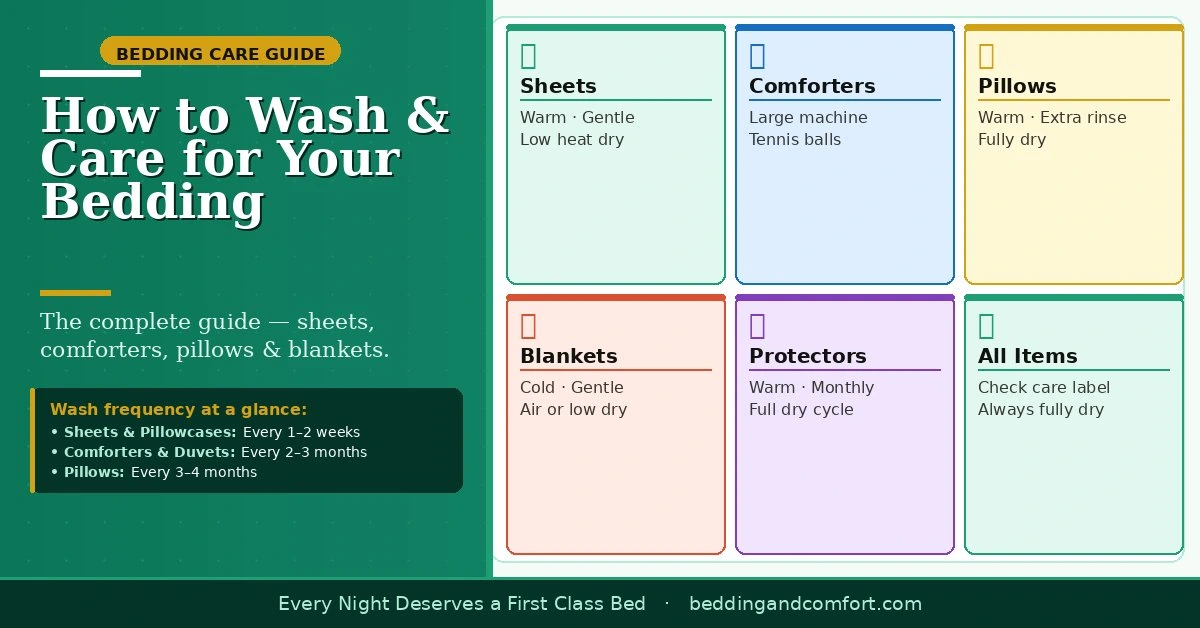
Quick Answer: Wash sheets and pillowcases every 1–2 weeks, comforters every 2–3 months, pillows every 3–4 months, and blankets every 1–2 months. Always check the care label first — water temperature, spin speed, and drying method vary significantly by fabric and fill type. Scroll to the Full Care Guide for every bedding type.
Most people wash their sheets when they remember to — which is usually less often than they should, and sometimes with the wrong settings. The result is bedding that wears out faster than it should, loses its softness after a few months, or worse, becomes a breeding ground for dust mites and allergens without any visible sign that anything is wrong.
Proper bedding care isn't complicated — but it does require knowing the right temperature, cycle, detergent, and drying method for each type of bedding. This guide covers everything: sheets, pillowcases, comforters, duvets, pillows, and blankets — with specific instructions for each material and a washing frequency guide so you always know when it's time.
How Often Should You Wash Your Bedding?
Before getting into how to wash each item, it helps to know how often. Most people significantly under-wash their bedding — particularly pillows and comforters — which shortens the life of the product and degrades sleep hygiene over time.
| Bedding Item | Wash Frequency | Why |
|---|---|---|
| Sheets & Pillowcases | Every 1–2 weeks | Direct skin contact — sweat, oil, and dead skin cells accumulate daily |
| Pillowcases (face contact) | Every 2–3 days | Face oils and hair products transfer nightly — linked to skin breakouts |
| Comforters & Duvets | Every 2–3 months | Protected by duvet cover — but fill still absorbs moisture over time |
| Pillows | Every 3–4 months | Absorb sweat, skin oils, and dust mites through pillowcases over time |
| Blankets & Throws | Every 1–2 months | Depends on use — sofa throws need washing more frequently than bed blankets |
| Mattress Protector | Every 1–2 months | First line of defence for the mattress — moisture and allergen barrier |
How to Wash Sheets & Pillowcases
Sheets are the most frequently washed bedding item — which means they're also the most frequently damaged by incorrect washing. The two most common mistakes are washing in water that's too hot and over-drying. Both weaken cotton fibers over time, causing premature pilling, fading, and loss of softness.
Cotton Sheets (Percale & Sateen)
- Water temperature: Warm (not hot) — 40°C / 104°F maximum. Hot water causes shrinkage and weakens fibers.
- Cycle: Gentle or permanent press — avoids excessive agitation that causes pilling.
- Detergent: Mild liquid detergent — powder can leave residue in the weave. Avoid bleach on coloured sheets.
- Drying: Low heat tumble dry — remove while slightly damp and smooth flat to reduce wrinkles. Over-drying is the primary cause of premature fiber breakdown.
- Avoid: Fabric softener — it coats the fibers and reduces breathability over time. Dryer sheets are fine occasionally.
Microfiber Sheets
- Water temperature: Cold — heat damages synthetic fibers and causes static buildup.
- Cycle: Gentle — microfiber is delicate and can pill with heavy agitation.
- Detergent: Small amount of mild liquid detergent — microfiber needs less detergent than cotton.
- Drying: Low heat or air dry — high heat melts microfiber filaments and permanently reduces softness.
- Avoid: Washing with cotton or towels — microfiber attracts and traps lint from other fabrics.
Satin & Silk Sheets
- Water temperature: Cold only — even warm water can cause satin to lose its sheen permanently.
- Cycle: Delicate only, or hand wash — never use a normal or heavy cycle.
- Detergent: Silk or delicate-specific detergent — regular detergents are too harsh for the fine weave.
- Drying: Air dry flat — never tumble dry. Direct sunlight fades satin; dry in shade.
How to Wash Comforters & Duvets
Washing a comforter is the bedding task most people get wrong — or avoid entirely. The key rule: always use a large capacity machine. A comforter crammed into a standard home washer won't clean properly and risks damaging both the machine and the fill. If your machine is under 4.5 cubic feet, take the comforter to a laundromat with a commercial washer.
Synthetic / Down Alternative Comforters
- Water temperature: Warm — cold won't fully clean oils and warm activates the detergent effectively.
- Cycle: Gentle with an extra rinse cycle — synthetic fill needs thorough rinsing to remove all detergent.
- Detergent: Small amount of mild liquid — less than you'd use for a regular load. Too much creates excess suds that are hard to rinse from fill.
- Drying: Low heat with 2–3 clean tennis balls — the balls break up clumping fill as it dries. Run an extra drying cycle to ensure the fill is completely dry before storage. Damp fill mildews rapidly.
Down Comforters
- Water temperature: Warm — cold water doesn't penetrate down clusters effectively.
- Cycle: Delicate with an extra rinse — down is fragile under agitation.
- Detergent: Down-specific detergent only — regular detergent strips the natural oils from down clusters, permanently reducing loft and warmth.
- Drying: Low heat only with 3 clean tennis balls — down takes significantly longer to dry than synthetic fill. Run 2–3 drying cycles and check that the fill is completely dry throughout before putting back on the bed.
- Alternative: Professional dry cleaning every 2–3 washes extends the life of quality down significantly.
How to Wash Pillows
Pillows are the most under-washed item in most bedrooms. Most people replace them when they go flat or yellow — but regular washing actually extends pillow life significantly by preventing the oil and moisture buildup that causes both discolouration and fill compression. Most pillows are fully machine washable; the method depends on fill type.
Down & Down Alternative Pillows
- Load two pillows at once to balance the drum and ensure even washing throughout.
- Warm water, gentle cycle, with an extra rinse to remove all detergent from the fill.
- Dry on low heat with tennis balls — run at least two full drying cycles. Down that feels dry on the surface can still be damp inside, leading to mildew and odour.
- Fluff and reshape by hand every 30 minutes during drying.
Memory Foam & Latex Pillows
- Do not machine wash — the agitation tears the foam structure internally even if it looks fine afterward.
- Spot clean only using a damp cloth with mild detergent — work gently and blot rather than rub.
- Air dry flat — never put memory foam or latex in a dryer. Direct heat causes permanent structural breakdown.
- Wash the cover (if removable) separately on a gentle cycle — this is your primary cleaning mechanism for foam pillows.
How to Wash Blankets & Throws
Sherpa & Fleece Blankets
- Cold water, gentle cycle — heat causes Sherpa to pill and mat permanently.
- Mild detergent only — fabric softener clogs the fleece fibers and destroys the plush texture.
- Air dry or tumble dry on no-heat setting — even low heat can mat Sherpa pile.
- Shake and fluff while damp to restore the pile texture before it fully dries.
Faux Fur & Weighted Blankets
- Cold water, gentle cycle — faux fur is a synthetic pile fabric that's heat-sensitive.
- Brush gently with a soft-bristle brush while air drying to restore the fur texture.
- Weighted blankets: check the weight limit of your machine. Most home machines handle up to 15–20 lbs. Heavier weighted blankets (20 lbs+) should go to a commercial laundromat washer.
- Dry on low heat or air dry — never high heat.
Real Situations — What to Do
Situation 1: Your comforter smells musty but has no visible stains.
Musty smell almost always means moisture trapped in the fill — either from incomplete drying after washing, or accumulated body moisture over several months. Wash on warm, gentle cycle with an extra rinse, then dry completely on low heat with tennis balls. Add a cup of white vinegar to the rinse cycle as a natural deodoriser without damaging the fill.
Situation 2: Your white sheets are yellowing despite regular washing.
Yellowing is caused by body oils and sweat binding to cotton fibers — hot water and bleach actually worsen it over time by setting the oils. Instead, pre-soak in warm water with oxygen-based whitener (not chlorine bleach) for 30 minutes before washing. A half cup of baking soda added to the wash cycle also helps lift yellowing naturally.
Situation 3: Your pillow has gone flat but doesn't smell — should you replace or wash?
Flatness in a down or down alternative pillow usually means compressed fill — which washing and drying with tennis balls can often restore. Wash on warm, gentle cycle, dry thoroughly with tennis balls, and fluff every 30 minutes. If the pillow is still flat after a complete wash-dry cycle, the fill has reached the end of its life and replacement is the right call.
Situation 4: Someone in your household has allergies and you want to minimise dust mites.
Wash sheets and pillowcases every week in water at 60°C / 140°F — this temperature kills dust mites reliably. Use hypoallergenic detergent with no fragrance. Encase pillows and the mattress in allergen-proof covers that wash separately. Wash comforters monthly rather than every 2–3 months. A fortnightly pillow wash schedule also significantly reduces mite exposure.
Quick Care Guide: The Right Settings at a Glance
Cotton sheets & pillowcases: Warm water • Gentle cycle • Mild liquid detergent • Low heat tumble dry • Remove slightly damp
Comforters & duvets: Large-capacity machine • Warm, gentle, extra rinse • Down detergent for down • Low heat + tennis balls • 2–3 drying cycles minimum
Pillows: Down & synthetic — warm, gentle, extra rinse, low heat + tennis balls • Memory foam & latex — spot clean only, air dry flat • Never machine wash foam
The Bottom Line
Proper bedding care is straightforward once you know the right settings for each item. The two rules that apply to almost everything: use less heat than you think you need, and always ensure fill is completely dry before putting it back on the bed. Those two habits alone will dramatically extend the life of every bedding item you own.
And if your bedding has reached the end of its life regardless of care — sheets that pill, pillows that won't refluff, comforters that clump — it's time for a fresh start. Browse our full bedding collection at Bedding and Comfort to find replacements across every category.
