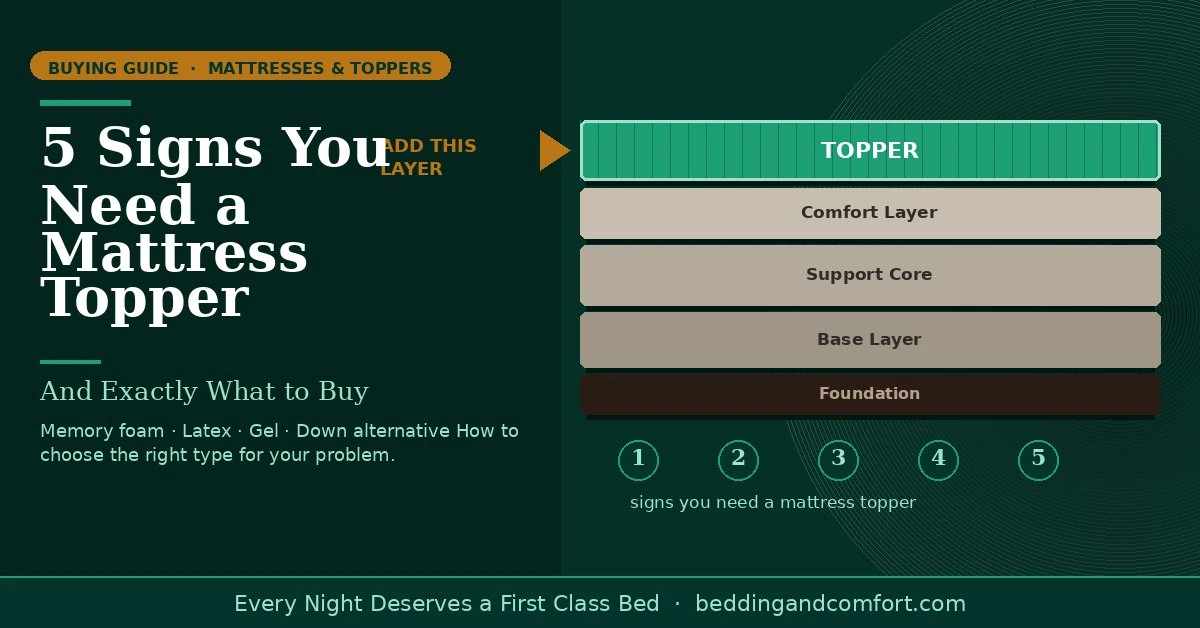
Quick Answer: A mattress topper is worth buying if your mattress is too firm, too soft, causing pressure points, or starting to wear unevenly — but the underlying structure is still sound. If your mattress has visible sagging or damage, a topper won't fix it. Scroll to the Quick-Pick Guide to find the right topper type for your situation in 30 seconds.
A mattress topper is one of the most cost-effective upgrades you can make to a bedroom — but only in the right situation. Used correctly, a topper can transform a too-firm mattress into a comfortable sleep surface, extend the life of a mattress that's starting to wear, or add a layer of specialised support for back or joint pain. Used in the wrong situation, it's money spent on a surface fix for a structural problem.
This guide helps you work out which situation you're in, which type of topper solves your specific problem, and what to buy at every budget level.
5 Signs You Actually Need a Mattress Topper
Sign 1: You wake up with pressure point pain on your hips, shoulders, or knees.
Pressure point pain happens when a mattress is too firm for your body weight and sleep position — it pushes back against the bony points of your body rather than contouring around them. A 2–3 inch memory foam or latex topper provides the contouring layer your mattress is missing without replacing the entire bed.
Sign 2: Your mattress feels too soft and you're sinking in rather than sleeping on top.
Sinking creates a hammock effect that misaligns the spine, especially for back and stomach sleepers. A firm latex topper adds the support layer on top of a too-soft mattress, effectively raising the sleep surface to a firmer level without buying a new bed.
Sign 3: Your mattress is wearing unevenly or developing soft spots — but the core is still structurally sound.
Uneven wear creates inconsistent support across the sleep surface. If the core of your mattress still has structural integrity (no visible sagging deeper than 1.5 inches), a topper levels the surface and buys significant additional life from the mattress. If the sagging is deeper, a topper will conform to the indentation and won't fix the problem.
Sign 4: You or your partner sleep hot and the mattress is retaining heat.
Memory foam mattresses in particular are known for trapping body heat. A gel-infused memory foam topper or a latex topper (which has an open-cell structure that allows airflow) can significantly reduce heat buildup at the sleep surface without replacing the mattress.
Sign 5: You have a guest room mattress that rarely gets used and feels stiff from sitting empty.
Infrequently used mattresses stiffen over time. Rather than replacing a mattress that sees light use, a medium-firm down alternative topper softens the surface to guest-comfort levels at a fraction of the cost.
When a Mattress Topper Won't Help
A topper is a surface solution. It cannot fix structural problems with the mattress underneath it. If your mattress has any of the following issues, a topper will conform to the damage rather than correcting it — and the underlying problem will continue to affect your sleep.
Signs You Need a New Mattress, Not a Topper
- Visible sagging deeper than 1.5 inches — a topper will dip into the indentation and replicate the problem on the surface
- Broken or protruding springs — a structural failure that no surface layer can compensate for
- Persistent musty or chemical smell — usually indicates mold, mildew, or off-gassing from degraded foam that a topper won't contain
- Mattress over 8–10 years old with consistent sleep problems — at this age, internal compression and material breakdown affect the entire sleep surface and a topper provides diminishing returns
- Waking up feeling unrested regardless of sleep hours — may indicate the mattress has lost its ability to provide restorative spinal alignment
Mattress Topper Types: Which One Solves Your Problem?
| Topper Type | Firmness | Best Problem to Fix | Price Range | Lifespan |
|---|---|---|---|---|
| Memory Foam | Medium–Soft | Too firm, pressure points | $50 – $200 | 3 – 5 years |
| Latex | Medium–Firm | Too soft, hot sleepers | $100 – $300 | 5 – 8 years |
| Down Alternative | Soft | Stiff guest mattress, extra softness | $30 – $120 | 2 – 3 years |
| Gel Memory Foam | Medium | Heat retention + pressure points | $80 – $250 | 3 – 5 years |
| Wool | Medium | Temperature regulation, natural materials | $150 – $400 | 5 – 10 years |
How Thick Should Your Topper Be?
Thickness determines how much the topper changes the feel of your mattress. More isn't always better — too thick a topper can compromise the support structure of a good mattress below it.
Thickness by Use Case
- 1 inch — minor softening only. Good for a mattress that's 90% right but needs a slight surface adjustment.
- 2 inches — the most versatile thickness. Enough to meaningfully change firmness without undermining support. Best for most people in most situations.
- 3 inches — significant comfort change. Best for a mattress that's clearly too firm or for heavy sleepers who need more contouring depth.
- 4 inches+ — essentially a new sleep surface. Use only when the mattress below has good structural support but needs a complete feel overhaul.
Quick-Pick Guide: Find Your Topper in 30 Seconds
Mattress TOO FIRM / pressure points: Memory foam topper • 2–3 inches • Medium-soft • Conforms to body shape • $50–$200
Mattress TOO SOFT / sinking in: Latex topper • 2 inches • Medium-firm • Adds support without removing bounce • $100–$300
Sleeping HOT / heat retention: Gel memory foam or latex • 2 inches • Open-cell structure for airflow • Gel dissipates heat • $80–$250
The Bottom Line
A mattress topper is one of the highest-value bedding upgrades available — but only when it's the right tool for the job. If your mattress has a surface feel problem (too firm, too soft, too hot, or unevenly worn but structurally sound), a topper can solve it for a fraction of a new mattress cost. If the problem is structural, save the money and invest in a new mattress instead.
At Bedding and Comfort, our mattresses and toppers collection covers every sleep situation — from soft down alternative pads to firm latex toppers and full mattress replacements.
