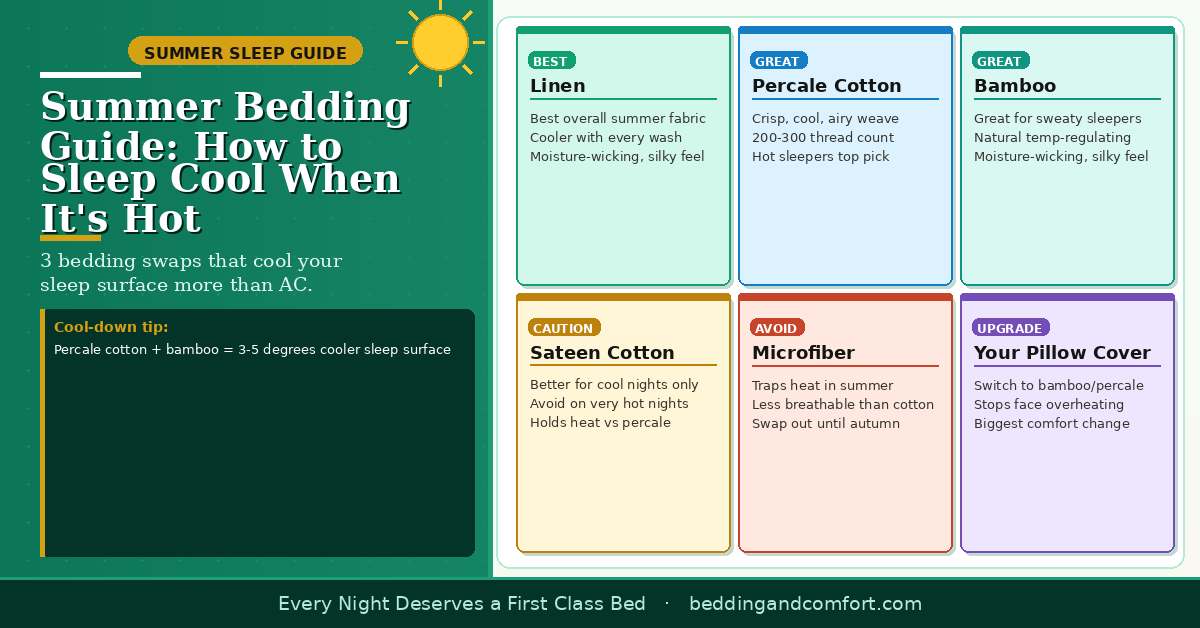
Quick Answer: For hot weather: swap to percale cotton or linen sheets (200–300 thread count), replace heavy comforters with a lightweight cotton or bamboo blanket, and switch to a breathable pillow cover. These three changes alone will reduce nighttime temperature by 2–4 degrees Fahrenheit. Scroll to the Summer Swap Guide below for a complete checklist.
Poor sleep in summer is one of the most common sleep complaints — and one of the most fixable. Most people blame the heat itself, but the real culprit is usually what's on the bed: sheets that trap heat, a comforter that's still in winter mode, and a pillow that holds warmth against the face all night.
The good news is that strategic bedding swaps are far more effective than running air conditioning all night — they address the root cause (heat retention at the sleep surface) rather than trying to cool an entire room. This guide covers every layer of the bed, from mattress to pillowcase, and gives you a specific swap for each one that will make a measurable difference.
Why Your Bedding Matters More Than Your Thermostat
The body's core temperature needs to drop by 1–2 degrees Fahrenheit to initiate and maintain sleep. This is why falling asleep in a very warm room is difficult — the body can't complete its pre-sleep cooling cycle when the ambient temperature is too high. But the most immediate thermal environment during sleep isn't the room — it's the microclimate directly between your body and your bedding.
A heavy comforter traps heat in this microclimate regardless of room temperature. Swapping to breathable bedding allows body heat to dissipate into the room air, keeping the sleep surface 3–5 degrees cooler than an equivalent heavy layer would. That difference is typically enough to eliminate most summer sleep disruption without any change to room temperature.
How Different Fabrics Handle Heat
| Fabric | Breathability | Moisture Wicking | Summer Rating |
|---|---|---|---|
| Linen | ★★★★★ | ★★★★★ | Best — gets cooler with washing |
| Percale Cotton | ★★★★★ | ★★★★ | Excellent — crisp and cool |
| Bamboo | ★★★★ | ★★★★★ | Excellent — especially for sweaty sleepers |
| Sateen Cotton | ★★★ | ★★★ | Moderate — better for cool nights |
| Microfiber | ★★ | ★★ | Avoid in summer — traps heat |
Layer-by-Layer Summer Swap Guide
Layer 1 — Sheets: Switch from sateen or microfiber to percale cotton.
Percale's tight, even one-over-one-under weave maximises airflow at the sleep surface. A 200–300 thread count percale sheet sleeps 2–3 degrees cooler than an equivalent sateen sheet. Wash in cold water weekly during summer — body oils accumulate faster in warm weather and reduce breathability.
Layer 2 — Top layer: Replace your comforter with a lightweight cotton or bamboo blanket.
A heavyweight comforter designed for winter creates a thermal seal around the body regardless of room temperature. Swap to a lightweight woven cotton blanket (under 200 GSM) or a bamboo throw for summer. Keep the comforter in storage — don't just fold it at the foot of the bed where it will tempt use in the middle of the night.
Layer 3 — Pillow cover: Switch to a cooling pillowcase.
The face and head generate significant heat during sleep, and a warm pillowcase against the face is one of the most disruptive sleep temperature issues. A percale cotton or bamboo pillowcase dissipates this heat rather than reflecting it back. If you frequently flip the pillow to find the cool side, this swap will eliminate that habit.
Layer 4 — Pillow fill: Consider a latex or buckwheat pillow for summer.
Memory foam pillows retain significant heat against the face. Latex pillows have an open-cell structure that allows airflow through the fill. Buckwheat pillows allow even more airflow and don't retain heat at all — though they require adjustment if you're not used to the firmer, rustling texture. Either is a significant improvement over memory foam in warm weather.
5 Bedding-Based Cooling Tips That Actually Work
What to Do
- Egyptian cotton sheets: Long-staple fibers produce a naturally smoother, less insulating surface. A 300 TC Egyptian cotton percale sheet sleeps cooler than a 600 TC sateen in the same room temperature.
- Pre-cool your pillow: Place your pillowcase in a sealed bag in the freezer for 10 minutes before bed. The cooling effect lasts 20–30 minutes — long enough for most people to fall asleep before the temperature differential disappears.
- Don't tuck in sheets in summer: Leaving sheets untucked allows cooler room air to circulate under the bedding rather than being sealed against the mattress surface.
- Wash sheets more frequently in summer: Body oils and sweat reduce fabric breathability — weekly washing in summer maintains the cooling properties of the fabric better than washing every two weeks.
- Two singles vs one shared: If you and your partner have different temperature preferences, two single blankets rather than one shared blanket is the most effective solution. Each person controls their own layer without affecting the other.
What Doesn't Help as Much as People Think
- Sleeping with no bedding: Counterintuitively, a light breathable sheet actually keeps you cooler than no sheet — it absorbs sweat and creates a slight cooling effect through evaporation. No sheet means all sweat sits directly on the skin.
- Very high thread count sheets marketed as cooling: A 1000 TC sheet with a sateen weave sleeps warmer than a 300 TC percale sheet regardless of what the marketing says. Weave matters more than thread count for summer.
Summer Swap Quick-Pick Guide
Sheets: Percale cotton or linen • 200–300 thread count • Wash weekly in summer • Leave untucked for airflow
Top layer: Lightweight cotton or bamboo blanket • Under 200 GSM • Store the winter comforter • Woven not knitted for best airflow
Pillow: Percale or bamboo pillowcase • Latex or buckwheat fill if overheating persists • Avoid memory foam pillows in summer
The Bottom Line
Summer sleep problems are almost always a bedding problem, not a room temperature problem. The three highest-impact changes — percale sheets, a lightweight top layer, and a breathable pillowcase — cost less than a single month of running air conditioning and produce better results at the sleep surface. Make those three swaps first and reassess before investing in cooling technology.
At Bedding and Comfort, our sheets collection includes percale cotton options for every budget, and our blankets range covers lightweight summer layers from cotton throws to bamboo blankets — all available now for the summer season.
